

How to find the right band knife?
Why choosing the right band knife matters
A band knife needs to match more than just the required length, width and thickness. What matters most is the material being cut and the task the knife performs in the machine. Soft foam behaves very differently during cutting than rubber, paper, textiles or bread. The requirements for the cutting edge and tooth profile therefore vary accordingly.
The first step is to determine what material is being processed and what type of cut is required. Is the material being cut straight, split or contour cut? Which dimensions are specified by the machine? And which cutting edge geometry is best suited to the required result?
An unsuitable band knife often becomes noticeable directly in the cut, for example through frayed edges, compressed material, increased cutting resistance or unnecessarily rapid wear. Choosing the right band knife therefore always starts with the material, the machine and the cutting task.
The 5 key factors when selecting a band knife
Material → Cutting task → Machine → Dimensions → Cutting edge
Material and cutting task determine the cutting edge
The material itself is not enough to determine which band knife is suitable. It is just as important to consider how the material behaves during cutting and what result is required. Soft foam can deform under pressure, rubber tends to spring back, textiles may fray along the cut edge, and bread should not be unnecessarily compressed or torn during cutting.
The cutting task also plays an important role. A straight cut places different demands on the band knife than contour cutting, splitting a material or a machine that is designed to cut in both directions. The cutting edge should therefore always be selected together with the material and the intended application.
Determining the correct machine and dimensions
Once the material and cutting task have been defined, the band knife must match the existing machine. Length, width and thickness cannot be selected freely, but depend on the design of the cutting machine and the intended application. Especially when replacing an existing knife, it is therefore advisable to use the current dimensions or the technical specifications of the machine as a reference.
Band knives for machines from different manufacturers
Especially in food processing, there are many different bread slicing and band knife machines. HaBuR manufactures band knives for machines from manufacturers such as Hartmann-Selectra, HOBA, IPEKA, Dovaina, UBE and AMF, as well as for machines from many other manufacturers.
The manufacturer name is useful for an initial identification, but is not sufficient on its own. Different machine series and models may require different band lengths, widths and thicknesses. The actual dimensions of the band knife currently in use therefore remain the most important reference.
If a suitable band knife is already installed, its dimensions can be used directly. Alternatively, the technical documentation of the machine or information about the manufacturer and machine model can help determine the correct dimensions.
The correct band length
The required band length is determined by the machine and may be specified in millimetres or inches, depending on the manufacturer or application. Typical sizes include 150″ (3,810 mm) or 176″ (4,470.4 mm), although many other lengths are also used.
The important point is that the length matches the roller system and the available tensioning range of the machine. The easiest way to determine it is by checking an existing band knife or the technical documentation of the machine.
If no sample is available, the manufacturer and machine model can help identify the correct length. The band length should be matched as precisely as possible so that the band knife can be installed and tensioned correctly.
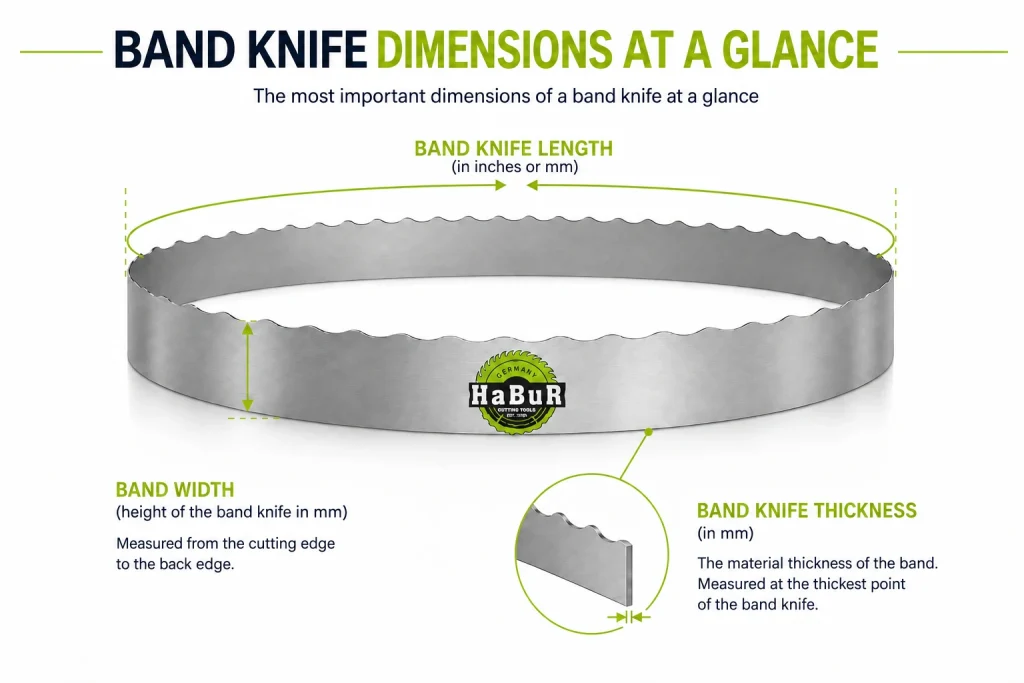
Band width and band thickness
Band width and band thickness influence how stable or flexible a band knife behaves during cutting. Both dimensions must therefore match the machine and the specific cutting task.
Band width mainly affects how the knife is guided. Wider band knives provide greater lateral stability and are therefore particularly suitable for long, straight cuts or for splitting and peeling material. If the band knife needs to follow changes in direction or tighter radii, a narrower version is required. The narrower the band, the more easily it can follow a contour. How narrow it can be depends on the machine, the guidance system and the required radius.
Band thickness affects the stiffness of the band and, at the same time, the bending stress it is exposed to. A thicker band is more dimensionally stable and can offer advantages where higher cutting forces are involved. At the same time, it must be bent and straightened again every time it passes around the rollers. The thicker the band is in relation to the roller diameter, the greater the stress placed on it. A greater thickness therefore does not automatically mean a longer service life or a better cut.
Soft and flexible materials are often processed with different band dimensions and guidance systems than those used, for example, when splitting dense or heavy materials. In some of these applications, significantly wider band knives are used so that the cutting edge remains stable over a long cutting distance. With contour cutting machines, by contrast, the flexibility of the band is more important.
Width and thickness should therefore not be considered separately. What matters is the combination of machine, roller diameter, guidance system, material and cutting task. If an existing band knife is being replaced and has already performed reliably, its current dimensions are the safest starting point. The dimensions should only be changed if both the machine and the application allow it.
Cutting edge geometries for band knives
There is no universal cutting edge for every application. A geometry that works well for bread may be the wrong choice for rubber, foam, paper or textiles. Depending on the material, the cutting edge may need to grip more aggressively, pass cleanly through the material or apply as little pressure as possible to the material being cut.
An unsuitable geometry usually becomes noticeable directly in the cut. Bread may be compressed or torn, textiles can fray, soft foams may deform, or the cutting resistance may become unnecessarily high. The cutting edge is therefore selected according to the material, cutting task and machine.
The following overview shows the cutting edge geometries and tooth profiles available from HaBuR.
Available tooth profiles


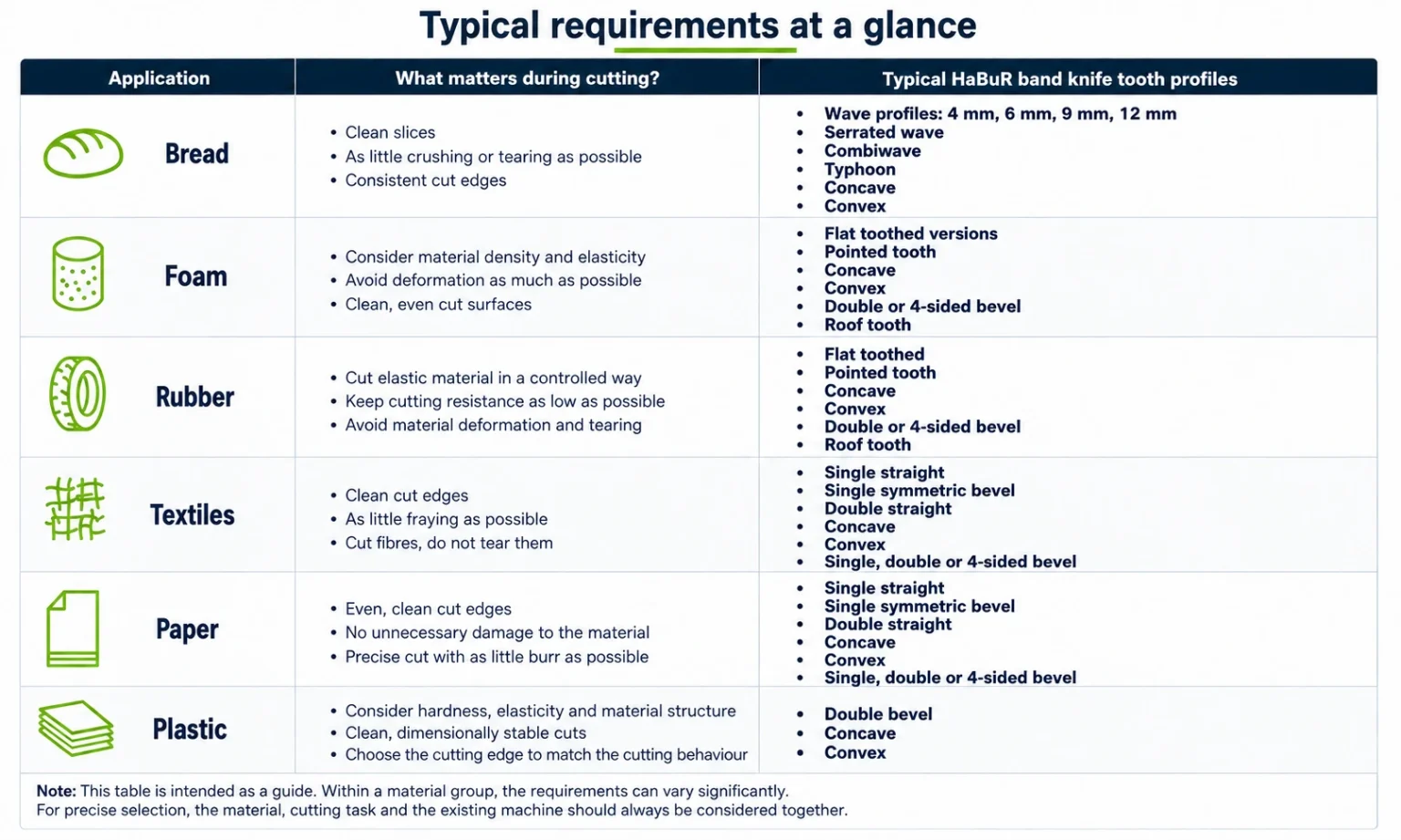
Band knives for bread
When cutting bread, the tooth profile has to handle two very different areas: the crust on the outside and the much softer crumb on the inside. The band knife must engage the crust reliably without unnecessarily compressing, tearing or heavily deforming the bread during cutting.
The Combiwave as well as the 6 mm and 12 mm wave profiles are among the tooth profiles frequently used by HaBuR. Which version is more suitable depends on the individual product. Crust, consistency, moisture content and the structure of the bread can all have a significant effect on cutting behaviour.
Other available tooth profiles include 4 mm wave, 9 mm wave, serrated wave, Typhoon, as well as concave and convex versions. This makes it possible to match the band knife to different types of bread and cutting tasks.
Band knives for foam and rubber
Foam and rubber behave very differently during cutting than rigid materials. Soft foams can deform under pressure, denser foams offer more resistance to the cutting edge, and rubber springs back due to its elasticity. The cutting edge must therefore be selected so that it engages the material in a controlled manner without unnecessarily compressing it or pushing it out of the cutting line.
Smooth or ground band knives are often used for softer foams. For denser, firmer or more difficult-to-cut materials, toothed versions can be useful because they penetrate the material more easily. Depending on the material and machine, different smooth or toothed band knife designs are therefore used.
HaBuR offers, among others, flat-toothed, pointed-tooth, concave and convex versions for foam and rubber. The most suitable version depends on material density, elasticity, cutting method and machine.
Band knives for textiles and paper
When cutting textiles, the main objective is to separate the fibres cleanly without unnecessarily fraying the cut edge or shifting the material during cutting. Different grinds are therefore used depending on the fabric, material thickness and construction. At HaBuR, straight cutting edges with a single-sided double or four-sided bevel are frequently used for these applications.
With paper, a clean and even cut edge is also the main priority. However, the requirements placed on the cutting edge vary depending on the application. Available versions include single straight edges, single symmetric bevels, double straight edges, as well as concave and convex geometries.
For both materials, the most suitable version depends on more than just the type of material. Material thickness, layer structure, required cut quality and the machine being used also play an important role in the selection.
What is the difference between smooth and toothed band knives?
A smooth cutting edge separates the material with a continuous cutting edge. It cuts without individual teeth engaging the material one after another. This is particularly useful when a uniform cut surface is required or when the material should be subjected to as little stress as possible during cutting. For soft foams, textiles and certain paper or splitting applications, ground band knives are therefore often used.
A toothed edge changes the way the knife engages with the material significantly. Instead of one continuous cutting edge, individual tooth or wave sections come into contact with the material. This can help the band knife penetrate dense, firm or elastic materials more easily and, depending on the application, reduce the pressure required for the cut. How aggressively the cutting edge works depends strongly on the tooth shape and tooth pitch. A fine tooth profile behaves differently from a coarse tooth, while a wave profile behaves differently again from a pointed or flat tooth.
An important distinction must be made between a toothed band knife and a band saw. The teeth of a toothed band knife are generally not set. The material is cut rather than removed through a wider kerf as with a conventional saw. This is especially important when cutting foam, because toothed band knives can still be used for largely chip-free and dust-free cutting.
The most suitable version therefore cannot be determined simply by choosing between “smooth” and “toothed”. The decisive factors are the tooth shape or grind, material density and elasticity, the required cut surface and the way the band knife is guided in the machine.
Single-sided and double-sided band knives
With a single-sided band knife, the cutting edge is located on only one longitudinal side of the band. The opposite side remains as the back of the knife and, depending on the machine, can also be used to guide and stabilise the band knife. These versions are mainly used where the cut is made in one defined direction.
The design of this single cutting edge can still vary. A single straight edge, for example, has a different grind from a single symmetric bevel. What both versions have in common is that only one side of the band knife is used for cutting.
With double-sided band knives, cutting edges are located on both longitudinal sides. In machines designed for this purpose, cutting can therefore take place in both the forward and return direction. This can be useful when the band knife should not return after a cut without performing another cutting operation.
Whether a single-sided or double-sided version is required is determined primarily by the machine and the intended movement sequence. The material, guidance system and required cutting edge geometry must also be suitable. A double-sided band knife is therefore not automatically the better option, but is intended for specific machine designs and cutting processes.
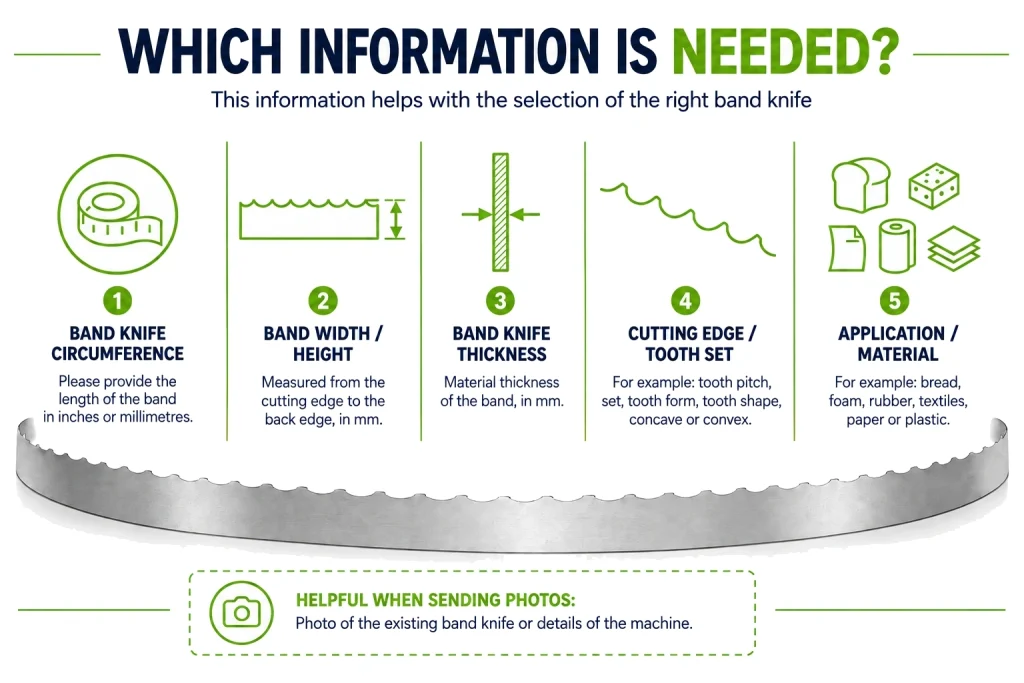
The right band knife for your machine
You know your machine and application, but are still unsure about the required dimensions or design? Send us the available data, a photo or a sample of the band knife currently in use. We will check which version is suitable for your machine and prepare an individual quotation for you.